Company data on company ground: server room, KyberFusion or both
Picture a family company that makes cardboard packaging. The server in the cupboard is old, the person who set it up left years ago, and nobody has installed an update in a long time. A consultant suggests moving everything to a cloud subscription: contracts, price lists, payroll, the customer list. It is easier, and for a while it really is. Then the price goes up at renewal, the export the company asks for turns out to be a paid project, and a new SI feature appears in the settings, switched on by default, that “learns from your documents”.
Meanwhile the month-end report, which used to take the old server all night, is exactly the kind of job the company would like to run faster without sending its payroll anywhere.
The real cause: a false choice
The choice is usually presented as two boxes. Keep it in your own cupboard: private, but limited, and only as safe as the last person who looked after it. Or rent it in a cloud: powerful and convenient, on someone else’s terms. Both boxes skip the questions that actually decide whether the data is the company’s: who holds the keys, who can read it without asking, what else is learned around it, and whether you can take all of it and leave.
Where company data goes wrong
A server nobody updates. A general-purpose server that drifts for years becomes the weakest machine in the building. Owning it is not the same as being safe on it.
A cloud you cannot leave. Cheap until your work and history are inside, then priced at whatever leaving would cost. The lock-in is in the export, not in the contract.
Keys held by the landlord. If the provider holds the encryption keys, the data is encrypted for them, not from them.
Metadata that tells the story anyway. Even when the content is protected, the account, the payments, the timing and the logs describe the business. What a cloud node knows about you goes through what leaks besides the content.
All or nothing. When everything lives in one place, payroll and the newsletter list get the same treatment, and the decision about where data lives is made once, for all of it.
Both, by rule
KYBERIOS keeps the company’s data on the company’s ground and borrows power only where a written rule allows it.
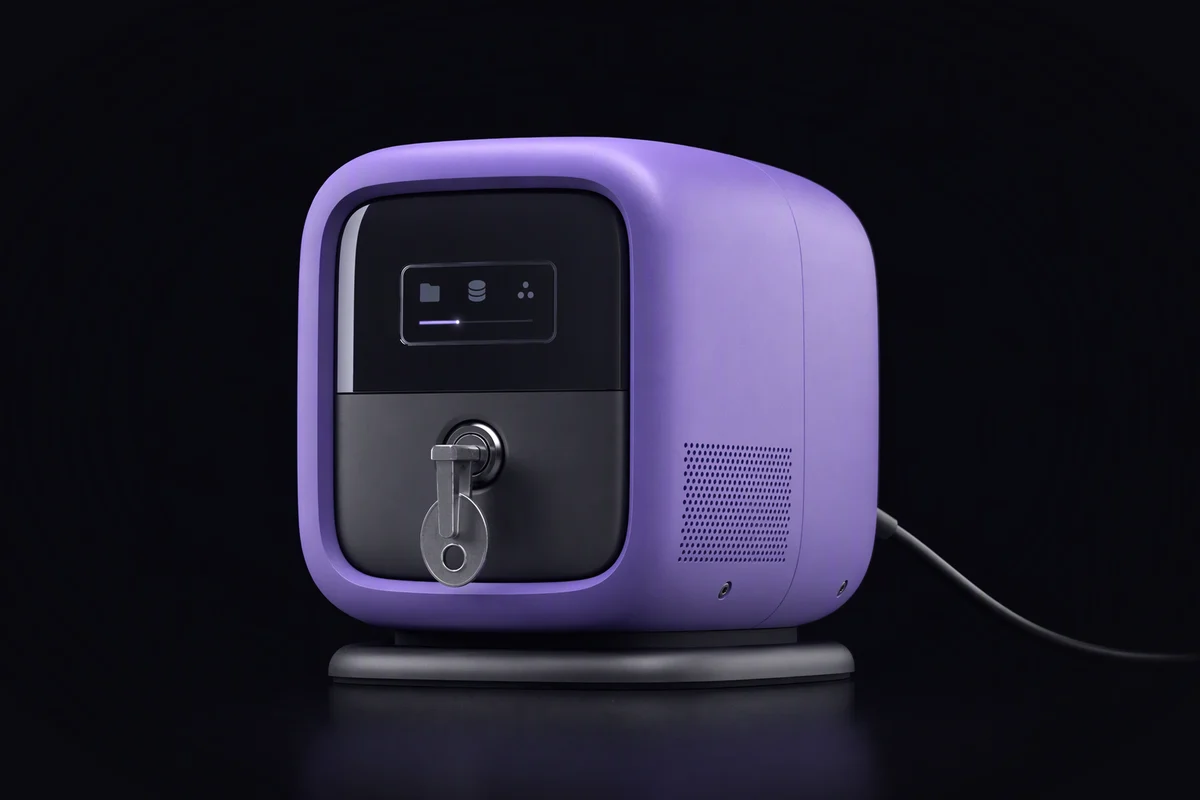
The office server is the company’s ground. A KyberDeck Node, or any server the company already owns, running KyberLinux, holds the company memory, the ledger and the cells the agents work in. KyberLinux on hardware you already own covers the hardware side.
A server a small company can keep. KyberLinux is designed to be immutable, verified at boot and updated atomically, so an update applies completely or not at all, and the machine in the back room does not depend on someone remembering to look after it.
The company holds the keys. Data on the server is encrypted under keys the company holds. No key, no data, for us or for anyone who carries the box away.
Extra power from KyberFusion, by rule. When the month end, a large report or a model too big for the box needs more, KyberFusion lends compute. The job leaves encrypted, runs on a node with the same KyberLinux, and the network is built with the goal of keeping it unlinked from the company. KyberLinux as a KyberFusion node explains why the rules travel with the job.
A policy decides what may leave. Which kinds of data may go to KyberFusion at all, which never may, and who approves the exceptions are written in the same policy as everything else. Payroll can be marked “never”; the product catalogue can be marked “always”. Where a swarm should run has the reasoning per task.
Paid in tokens, and this is not an offer. Compute borrowed from KyberFusion is settled in tokens, a unit of settlement for compute between members. Tokens promise no return or price, nothing is for sale, and this is not an offer; who pays for the cloud sets out how the network is meant to pay its way.
Leaving is a file copy. The whole data model exports in an open format, so moving away is a copy, not a migration project.
None of it is released yet. The KYBERIOS homepage keeps the honest state of the work.
A test you can run today
List the five data sets your business could least afford to lose or leak. For many firms that is payroll, the customer list, prices and margins, contracts, and the bank. For each one, write down four answers:
- Where is it, physically?
- Who holds the key that decrypts it?
- Who could read it without asking you first?
- How would you get all of it out by Friday, in a format another system can read?
Every “I don’t know” marks data that sits on someone’s ground, just not demonstrably yours. Those are the first five things to bring home.
- data sovereignty
- server
- KyberFusion
- KyberLinux