Who owns a small company's agent factory
The most valuable part of a small company’s agent factory is not the model but what the factory learns about the company. Which orders need a call to the customer. Why the discount limit for regular buyers went up in March. Which exceptions come back every month. If that knowledge sits with a vendor, in its format and on its terms, the company does not own a factory. It rents one, along with its own experience.
Where the problem comes from
In the first piece in this series we described a loop in which agents prepare the office’s work and people approve whatever falls outside the rules. Week by week that loop collects something the company never had in one place before: written rules, a history of decisions, and the corrections people made.
In a small company that knowledge scatters faster than in a large one. The invoicing program gets its own assistant. The web shop gets another. The stock program promises “smart supplier reorders”. Each learns its own slice of the company, each has its own permissions, and the rule “a customer in a dispute gets no reminders” has to be entered in three places, in three different shapes. After a year the company has three factories, and none of them is its own.
What you actually own when you have a factory
An agent factory is several layers. Each can belong to the company or to the vendor.
| Layer | What it is in a small company | What you lose if the vendor holds it | The minimum to keep |
|---|---|---|---|
| Policies | who may discount, pay or release goods, and up to what limits | rules the company refined on its own mistakes | plain text with version history, readable without the vendor’s program |
| Process plans | the plan a swarm follows to take an order or close the month | the way the office works, rebuilt from scratch later | files in the company that a new hire can read |
| Run trace | who or which agent changed what, under which rule, with what evidence | the answer to “why” a year later, for the accountant and an audit too | a record in one ledger on the company’s server |
| Company memory | notes on customers, suppliers, arrangements | knowledge that used to live in the sales reps’ heads | company memory kept apart from staff’s private memory |
| Set points and corrections | how often people correct the agents, and where agents get it wrong | the ability to test whether another model or vendor does better | your own numbers, measured on your own tasks |
| Model | which model does the work | the freedom to switch when price or quality changes | swapping the model without rewriting the policies |
| Compute | where the work physically happens | control over where the company’s documents go | the company’s server, with more power only by rule |
The model sits second to last. Models get cheaper and change every few months. Policies, trace and memory gain value with every week the factory runs. If you could take only one layer with you, take the policies, with their history.
Three roads and their price
Assistants built into rented programs. The fastest start: you switch on a feature in a program you already use. The price is that each program learns on its own, the rules live in its settings and the trace in its database. There is less and less to integrate, and more and more to move when you want to leave.
Your own scripts from scratch. Someone handy in the company, or a local IT contractor, wires the mailbox, the bank statement and a language model together. The first automation runs within a week. The price is that six months later the company’s knowledge lives in scripts one person understands, and every new process is a new project.
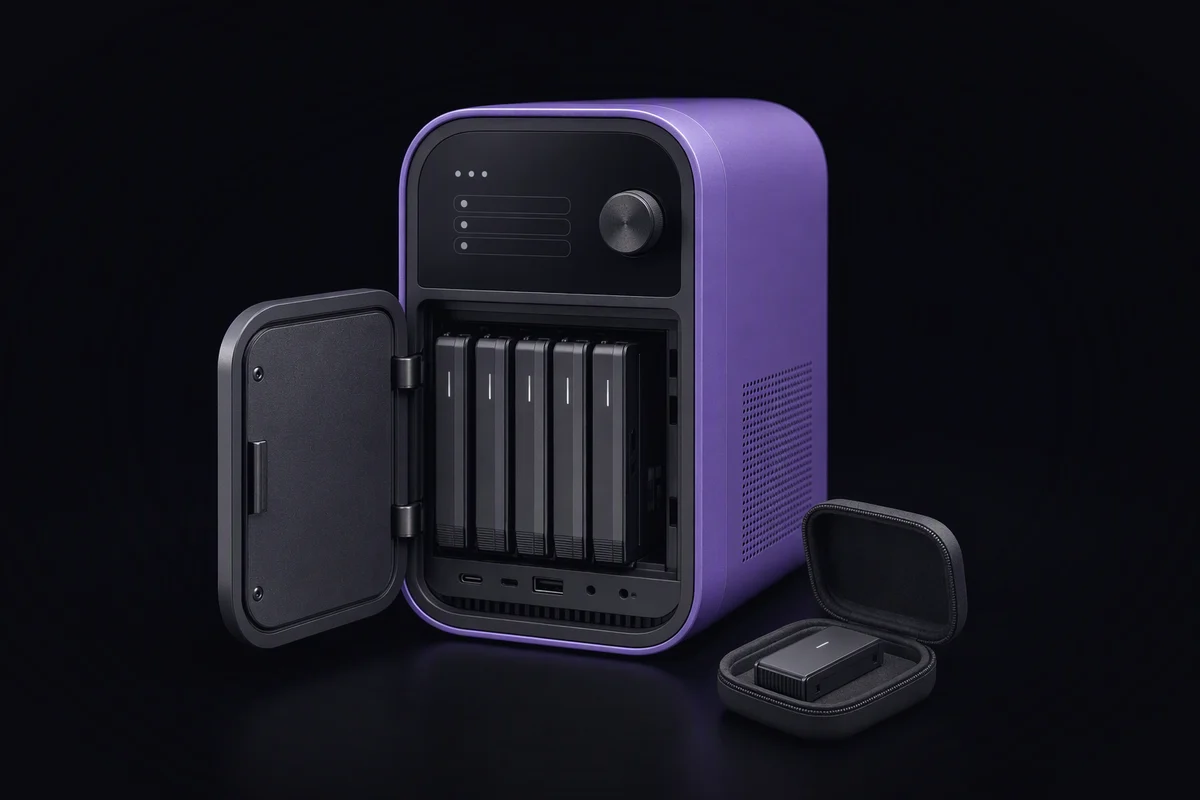
Your own system on your own ground. One data model, the policies and the trace on the company’s server, in an open format, with models that can be swapped. That is how we are designing KYBERIOS: leaving should be a file copy, not a migration project. The price is a server in the back room and someone who answers for it, in the company or at a partner who deploys and runs it. KYBERIOS is not available yet; this describes an intent, not a product on a shelf.
Where automation erodes sovereignty
Sovereignty is rarely lost in one decision. It is lost through defaults. An assistant that syncs the whole mailbox to the vendor’s cloud “for convenience”. An agent that accepts new terms of service because “it’s only an update”. A data export that exists on the price list but that nobody has ever run.
The rule of the whole series applies here too: the agent prepares, a person decides. Agreeing to send company data beyond its ground is a decision, not a setting. How to pass data to the accountant, the bank or the tax office without moving beyond the company’s ground is the subject of accountant, bank, tax office.
Where sovereignty becomes an expensive hobby
You can overdo sovereignty. A nine-person company does not need a rack of graphics cards to own its agent factory. Buying hardware nobody in the company can maintain ends with people going back to a chatbot in the browser, only now the company pays more.
For most small companies it is enough that the policies, trace and memory are theirs, that the contract with the compute provider rules out retention and training on their data, and that the model can be swapped within a week. In KYBERIOS the office server is meant to ship with models, and when the month-end close needs more power, KyberFusion lends it only where a rule allows. More on that choice in company data on company ground.
The second trap is the open model as a goal in itself. A local model is plenty for sorting order emails. For a difficult letter from a customer it may fall short. A factory makes sense when, at each stage, you pick the model that fits the task and the rule about the data.
How to measure sovereignty
Sovereignty is not measured by a statement. It is measured by the cost of leaving.
| Vanity metric | Outcome metric |
|---|---|
| “our vendor meets every requirement” | how many days it would take to move the policies, trace and memory to another system |
| “data export is available” | whether anyone rebuilt one order, with its history, from an export last quarter |
| “everything is in the cloud” | whether you can say why this customer got this discount without logging in to the vendor’s account |
Where to start on Monday
Run one test. List the programs where you have already switched on an assistant or an automation, and for each one answer: where are the rules it follows written down, and where is the record of its decisions? Then ask a second question: if we changed this program tomorrow, what would we have to work out again? If the answer is “everything we learned this year”, your factory, even in its infancy, already belongs to someone else.
The choice is easy to name and harder to make. You can build the factory quickly, out of features in rented programs, and accept that the knowledge of how your company works stays with the vendors. Or you can build it more slowly, on your own ground, and keep that knowledge at home. Both have a price. The most expensive one is the decision nobody made on purpose.
- agent factory
- data sovereignty
- small business
- policies
- exit cost