Android XR in a small company: whose platform holds the work
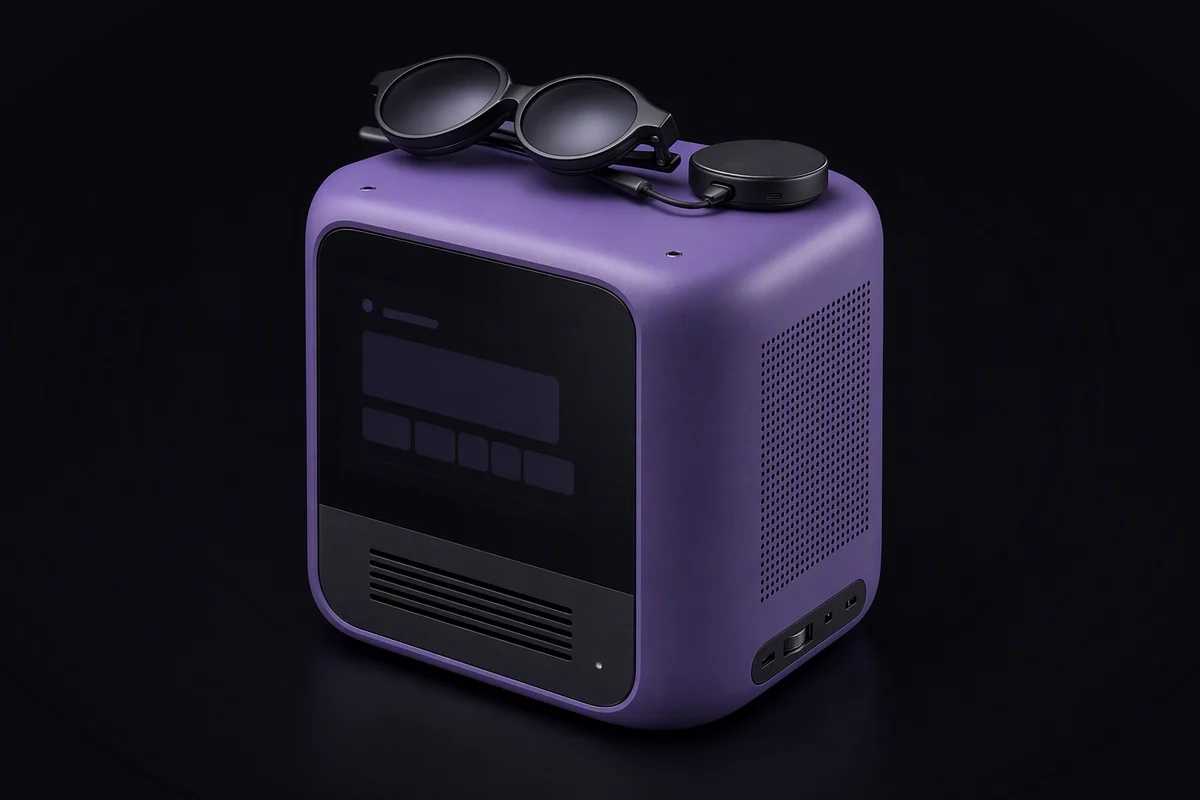
Picture a company of twelve that installs and services heat pumps. Six technicians spend their days in boiler rooms and basements, hands in the unit, phone in a back pocket. The owner watched Google show glasses on Android XR at Google I/O this year: audio glasses paired with a phone, the glasses as the voice and the camera, and the Gemini agent working through multi-step tasks on the phone in the background. He pictures a technician saying “close the job, order the valve, book the follow-up visit” while still holding the wrench.
It is a good picture. It also quietly moves the company’s work orders, photos of customers’ homes and the steps of its processes onto a platform the company does not run. The heat-pump company is hypothetical; the move is not.
What Android XR is, in a sentence or two
Android XR is Google’s platform for headsets, display glasses and audio glasses, developed with Samsung and Qualcomm, with Gemini as the assistant layer. The first device was Samsung’s Galaxy XR headset in October 2025. XREAL Aura is the first priced pair of display glasses on it, and Samsung has announced its own Gemini glasses for November 2026, without a price or an exact date. The Android XR developer documentation describes how apps for glasses are built; the part that matters here is that many of them run on a host device, usually a phone, and project the experience to the glasses.
For a European company there is one more fact: Aura’s first wave ships to the United States, Canada, Japan and South Korea, not to Poland or the rest of the EU.
The real cause: the device is the visible part
A small company buying glasses thinks it is buying hardware. What it is choosing is a platform: whose account the device signs in to, whose assistant interprets what the camera sees, whose store the app comes from, and whose servers the work passes through. For a consumer that bundle is the point. For a company it decides where its records live and who can change the terms.
Google does not publish how much of the agent’s work happens on the device, how much on the phone and how much in its cloud. That is not unusual for a platform this young, but it means a company cannot answer its own customers’ questions about where their data goes.
Where a platform quietly takes over
The assistant belongs to the platform. The steps of “close the job” live in the platform’s assistant, not in the company’s system. When the assistant changes how it works, the process changes with it, and nobody at the company approved the change.
Personal accounts doing company work. Audio glasses pair with the technician’s phone, often his own. The work order, the photo of the customer’s meter and the voice note end up under a personal account, and leave with him.
Steps in the background with no record the company keeps. A multi-step task run in the background is convenient precisely because nobody watches it. The company needs to know which step ran, on whose instruction and with what result, in its own records. A KyberBot for every employee sets out why company memory and private memory have to be kept apart.
The camera in someone’s home. The customer’s boiler room is their home. EU rules on data protection apply to the company that sends the technician in, and a company that cannot say where the frames went cannot answer the customer.
One vendor’s roadmap. Devices, APIs and the assistant come from one platform’s plan. If a feature the company relies on is renamed, moved or withdrawn, the company finds out when it stops working.
What to do instead
Keep the system of record in the company. Work orders, stock and customer history live in the company’s own system, on its own server or a cloud it chooses. The glasses read from it and write to it; they never become it. That is the idea behind an operating system for a small business.
Treat the glasses as a terminal. They show and they capture. Decisions, approvals and the record of who did what stay with the company’s rules. How an assistant that lives inside the system should be weighed is the subject of Android XR: the assistant in the system.
Ask where the stream goes, in writing. Which frames leave the device, where they are processed and how long they are kept. The cloud behind your eyes lays out why the answer matters more for a camera than for a keyboard.
Company accounts and one fleet list. Devices signed in to accounts the company controls, a list of who holds which, and a written leaver process.
Plan the way out before the way in. What happens to the data and the process if the company changes platform: Android XR with an exit clause covers that side.
KYBERIOS does not integrate with Android XR, and nothing on this site is for sale yet; the KYBERIOS homepage has the honest state. If you are weighing the glasses themselves, display glasses on the shop floor looks at where they help.
A test you can run today
Take one process that would move to glasses first, such as closing a job. On a sheet of paper, write each piece of data it creates: the note, the photo, the parts used, the customer’s signature. Next to each one, write three things: where it is stored today, under whose account, and who could delete it.
Then do the same for the glasses version, as far as the vendor’s documents let you. Every line where the answer moves from “our system” to “the platform’s account” is a decision, and it should be made by the company, not by the default settings.
- Android XR
- Gemini
- data ownership
- small business
- devices