Display glasses on the shop floor: where they help, where not
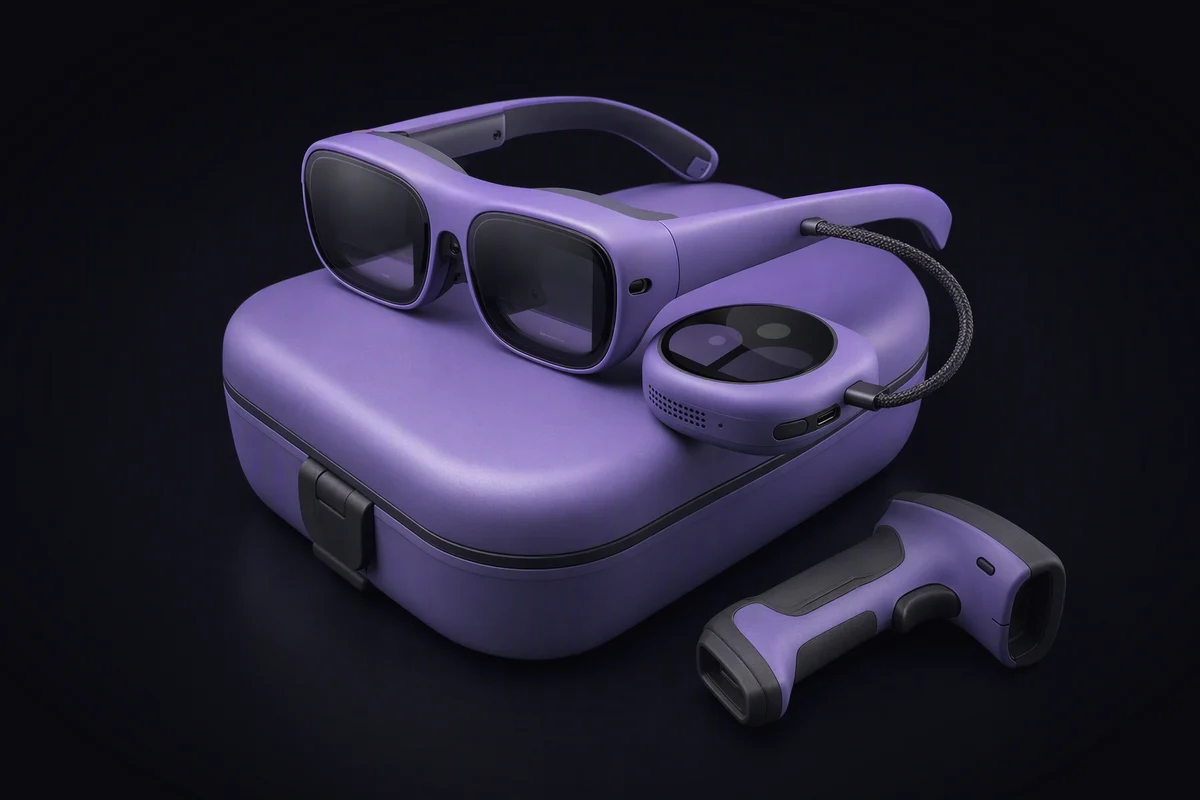
Picture a small wholesaler of spare parts for farm machinery: one warehouse, a counter, two vans. The owner has read that XREAL has opened pre-orders for Aura, display glasses built with Google on Android XR, with Gemini as the built-in assistant. He pictures the warehouse with them: a picker in gloves sees the next location in the corner of his eye, the assistant reads the label he is looking at, and the new hire assembling an unusual order follows instructions floating over the bench instead of calling the manager every ten minutes.
Then the questions start. How many pairs? Who wears them on the night shift? What does the camera see when it is pointed at the counter, where customers stand? And can he even buy them here?
The wholesaler is hypothetical. The glasses are not, so it is worth being precise about what they are before deciding where they belong.
What Aura actually is
According to XREAL’s product page, Aura is a pair of optical see-through glasses under 95 g with a 70° field of view, wired by cable to a compute puck that goes in a pocket. The puck carries a Qualcomm Snapdragon Reality Elite chip rated at 48 TOPS, a 4455 mAh battery, Wi-Fi 6E and GPS, and it doubles as a touchpad. The glasses have two tracking cameras for head and hand tracking and a high-resolution camera with a privacy light. It runs Android XR, has Gemini built in, and installs apps from Google Play.
Prices start at USD 1,279. Shipping starts in the United States, Canada, Japan and South Korea, with more markets in 2027. Poland and the rest of the EU are not in the first wave. A small European company that wants a pair today is looking at an import, with the warranty and service on another continent.
The real cause: a floor problem is rarely a display problem
Glasses solve one specific shape of problem: the hands are busy, the eyes are needed on the work, and the information is needed at that same moment. Most of the trouble on a small company’s floor has a different shape. The stock figure is wrong because a pick was written on paper, the pallet went out because nobody knew about the credit hold, the shared tablet says “warehouse” for everyone. KyberDeck on the shop floor walks through those. None of them is fixed by a better screen. They are fixed by one record, one identity per person and rules that hold on every device.
Where glasses on the floor go wrong
The price is per head, the work is per shift. At this price a pair is shared, and shared glasses mean a shared identity. Every pick confirmed through them belongs to whoever wore them last, which is the shared-tablet problem again, worn on the face.
The camera sees more than the task. It sees colleagues, customers at the counter and paperwork on the desk. The privacy light tells people they are being filmed; it does not ask them. EU rules on data protection apply to the company that points the camera, whatever the device does. An assistant that sees what you see looks at the same question from the assistant’s side.
Nobody can say where the frames go. XREAL does not set out which parts of the assistant’s work happen on the puck and which in the cloud. That is not an accusation, it is a gap. Before a camera looks at your stockroom, ask the vendor in writing.
An assistant that can act. Gemini on Android XR can open apps and move around the interface. On a phone that is a convenience. Pointed at the company’s order system, it is someone acting in an employee’s name, and the rules for what it may do do not live in the company’s system.
A cable and a battery on a body that lifts. A puck in a pocket and a cable to the temple are a sensible way to keep the glasses light, and glasses with a puck explains why the form makes sense. On a picker who bends, lifts and climbs a ladder all shift, it is a thing to try before buying, not to assume.
Where they could earn their place
There are jobs on a small company’s floor that have the right shape, and they are worth naming honestly:
Rare, complex assembly. An unusual kit or a machine nobody has serviced in a year, where the instructions matter more than speed.
Training at the bench. A new hire who needs the steps in front of them for the first weeks, not for the rest of their career.
Remote help on a visit. A technician at a customer’s site who needs a colleague to see what they see, with the customer told and agreeing.
Everywhere else, a wrist unit, a card for identity and a rule written once do more for less.
How we think about it in KYBERIOS
KYBERIOS is pre-launch and does not integrate with Android XR. What we design is the company’s side of the floor: one data model, one identity per person, and policies that decide who may release what, held by the company’s own server. If a company does put glasses on the floor, that design gives them a narrow job: they show and they capture, and every decision and every record stays in the company’s system, under the company’s rules. Whose platform holds that work is the subject of Android XR in a small company, and how a rollout of head-worn devices should be run is in rolling out display glasses to a team. The state of our own work is on the KYBERIOS homepage.
A test you can run today
Walk the floor for one shift with a notepad. Make a mark each time someone needs both hands and a piece of information at the same moment: they put the box down to read a screen, call a colleague or go back to the office to check. Next to each mark, write who else was in view at that moment.
If the marks are few, glasses are an expensive answer to a question your floor is not asking. If they are many and cluster around a few jobs, those jobs are your pilot, and the names next to them are the people you will need to talk to first.
- XREAL Aura
- Android XR
- warehouse
- shop floor
- devices